$20.67
$36.38
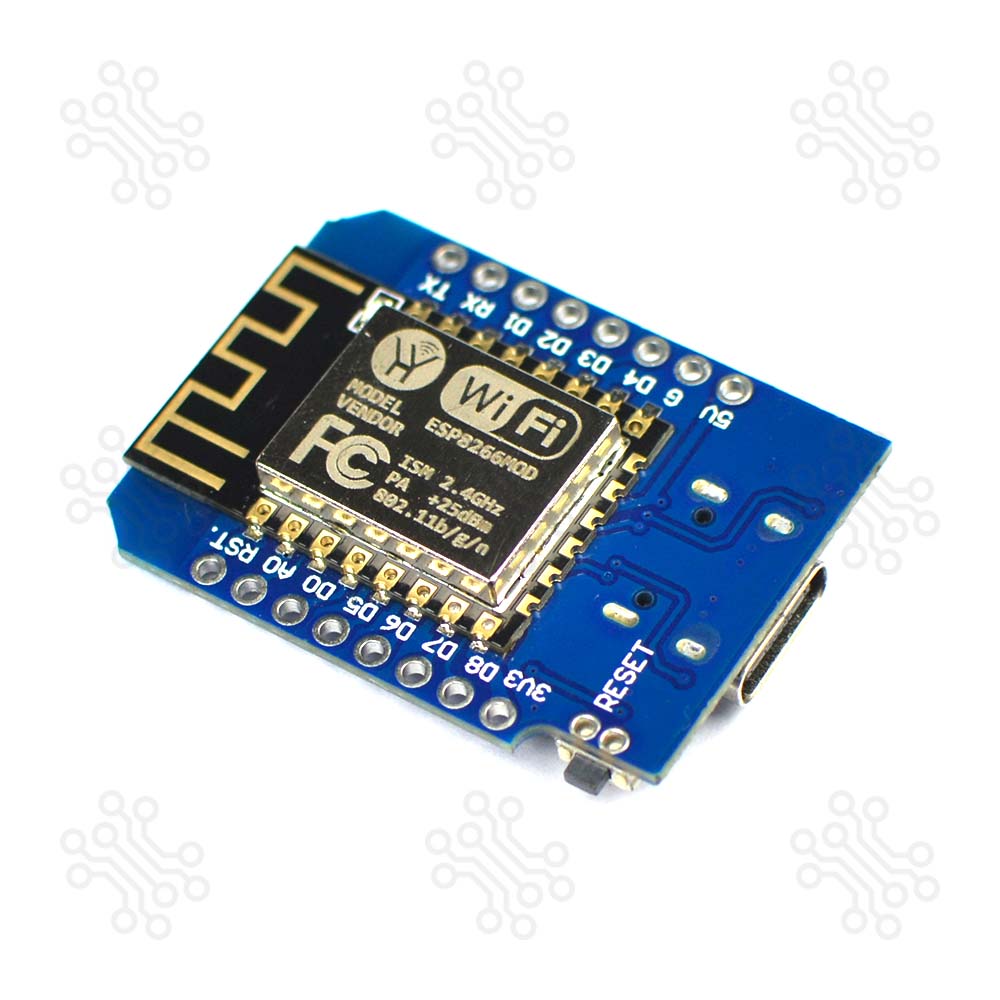
Description of Wemos D1 Mini ESP8266 WiFi NodeMCU IoT Module Wireless Microcontroller The Wemos D1 Mini is a budget-friendly, ESP8266‑based WiFi board which is compact yet and as powerful as any NodeMCU or ESP8266 board by Espressif Systems. It comes with built-in WiFi connectivity, making it an ideal choice for IoT (Internet of Things) projects, smart home devices, and small-scale automation systems. The D1 Mini is faster, more flexible, and lower in cost than traditional microcontrollers like Arduino or PIC, offering built‑in WiFi and strong online support for beginners. Why Choose this Wemos D1 Mini WiFi Module? If you’re building a small, modular, breadboard-friendly IoT project, the Wemos D1 Mini is the ideal choice over the NodeMCU. Compact size and breadboard-friendly design. Supports stackable shields. Easy programming with Arduino, Lua, MicroPython. Built-in Wi-Fi for IoT projects. Specification Parameter Details Processor Tensilica L106 32-bit RISC Clock Speed 80 MHz (up to 160 MHz) Flash Memory 4 MB SRAM 50 KB (Usable) WiFi 802.11 b/g/n (2.4 GHz) Bluetooth No GPIO Pins 11 (D0–D8, RX, TX) ADC 1 (10-bit) PWM Pins All GPIOs (software-supported) Antenna On-board PCB antenna Programming Port USB Type-C Logic Voltage 3.3V Input Voltage (via USB) 5V Dimensions 35 × 25 mm (±1 mm) Wemos D1 Mini WiFi Module Pin Diagram The D1 Mini board exposes 11 GPIO pins which can be used for digital I/O, PWM, I2C, SPI, and ADC functionalities. Pin GPIO Function Safe Remarks D0 GPIO16 Wake / No PWM / No I2C ⚠️ HIGH at boot; used to wake up from deep sleep D1 GPIO5 SCL / I2C ✅ General purpose D2 GPIO4 SDA / I2C ✅ General purpose D3 GPIO0 Flash button ⚠️ Connected to FLASH button; boot fails if pulled LOW D4 GPIO2 Built-in LED ⚠️ HIGH at boot; boot fails if pulled LOW D5 GPIO14 SCK / SPI ✅ General purpose D6 GPIO12 MISO / SPI ✅ General purpose D7 GPIO13 MOSI / SPI ✅ General purpose D8 GPIO15 CS / SPI ⚠️ Required for boot; boot fails if pulled HIGH RX GPIO3 UART RX ⚠️ Used for flashing/debugging; careful if repurposed TX GPIO1 UART TX ⚠️ Used for flashing/debugging; careful if repurposed A0 ADC0 Analog Input (0–3.3V) ⚠️ Input only; cannot be configured as output Digital and Analog I/O All of the digital I/O (except D0) support PWM and interrupts and can be configured with pull‑up or pull‑down resistors. There are 11 digital I/O pins total, but if serial TX/RX are used then 9 remain for general‑purpose use, and the on‑board blue LED is connected to pin D4 (GPIO2) and accessible via the LED_BUILTIN constant. The digital I/O is specified for 3.3 V, although many setups tolerate 5V logic. On the analog side, there is only a single 10‑bit ADC input, which may limit use for some sensor applications unless you add an external analog multiplexer or ADC module. The analog pin A0 must be limited to a maximum of 3.2 V or less, as the board includes a built‑in 100 K/220 K resistor voltage divider that reduces the input to about 1 V at the ESP8266 processor. NodeMcu or Wemos D1 Mini? Some NodeMCU boards are wider and longer than the Wemos D1 Mini, making them harder to use on breadboards. While NodeMCUs offer more pins, they take up more space. The D1 Mini is easy to upgrade and adjust. You can use pin, socket, or long-leg headers to connect or solder parts as needed, keeping your setup small and flexible. Wemos D1 Mini or ESP-01? The main differences are that the WeMos D1 Mini is a complete breadboard-friendly development board with more I/O pins, a USB port, and onboard circuitry, while the ESP-01 is a much smaller, compact module with only a few pins exposed, requiring more external components and a separate USB-to-serial programmer. Feature Wemos D1 Mini ESP-01 USB Port Built-in Requires external adapter I/O Pins 11 GPIOs 2 GPIOs Power 5V via USB 3.3V only Voltage Regulator Yes No The D1 Mini is better for beginners and quick project building, while the ESP-01 is best for projects with limited space that need only a few connections. Power Supply The module can be powered via the USB port or by using an external 5V power supply connected to the 5V pin. The onboard DE-A1D voltage regulator converts the 5V input to 3.3V, which powers the ESP8266 chip. The 3.3V pin provides a 3.3V output when the module is powered through USB or 5V, and this output can be used to power small external devices such as sensors. For best results, it’s recommended to power the module from 5V. How to Program? The ESP8266 D1 Mini can be programmed using various platforms, such as the Arduino IDE, PlatformIO with Visual Studio Code, and MicroPython. For a detailed Arduino setup guide, visit: How to Install ESP8266 Board in Arduino IDE Wemos D1 Mini Hookup Guide Application IoT Devices & Automation Smart Home Control Sensor Data Logging & Cloud Upload Wi-Fi Web Server/Client Mobile-Controlled Robots Documents Wemos D1 Mini Datasheet Wemos D1 Mini Schematic Wemos D1 Mini WiFi Module Mechanical Dimension Packaging Details 1 x ESP8266 D1 Mini Wi-Fi Module 2 x Long Female Header Connector 8 Pin 2 x Female Header Connector 8 Pin 2 x Male Header Connector 8 Pin Warranty and Replacement TechShopBD offers up to one year of warranty and replacement support for its products, depending on the supplier(s) and product(s). The specific warranty duration for each product can be found on the respective product page. To be eligible for warranty and replacement support, customers must agree to our terms and conditions. Attention Note: This item is non-returnable. If this item arrives damaged or is not functioning properly, please don’t hesitate to contact us to determine if further action is required. Need Help? Our engineers are available to assist you. If you have any queries, please leave a comment below or call 09678110110 from 09:00 am to 06:00 pm (7 days a week). You can also reach us via WhatsApp or Facebook Inbox.
Esp